

🖥️ Data centres are becoming Europe’s most-disclosed infrastructure
The EU now scores your data centre on a public label. Your audit Action Plan follows.


By 11 October 2026, large data centre operators face three converging EU obligations: an annual public filing already in its second cycle, a sustainability rating label expected to be adopted in June 2026, and a mandatory energy audit with an Action Plan submitted to senior management, which Member States are required to ensure is published in the enterprise's annual report and made publicly available, subject to trade and business secret protections under national law.
⚡ Why now
Article 12 of the recast Energy Efficiency Directive (Directive (EU) 2023/1791) created the first EU-wide mandatory reporting obligation for data centres in 2024 (Source: European Parliament and Council). The first reports were due by 15 September 2024 (the initial 15 May 2024 deadline under Article 12 EED was delayed to allow operators time to prepare following late adoption of the Delegated Regulation), covering 2023. Annual filings by 15 May have followed.
What changes in 2026 is the stack. The European Commission is finalising a second Delegated Regulation that turns the raw KPIs into a public sustainability rating label for every data centre on the database. In parallel, Article 11 of the same Directive imposes its first mandatory energy audit deadline on any enterprise consuming over 10 TJ per year, which captures nearly every operator already in scope of Article 12. The audit must produce a concrete, published Action Plan.
🔍 Who is in scope
Article 12 reporting (already in force):
Operators of data centres with an installed IT power demand of at least 500 kW (Source: Commission Delegated Regulation (EU) 2024/1364)
Reporting goes to the European database, either directly or via a national platform where transposed
Article 11 audit and EMS obligations (new in 2026/2027):
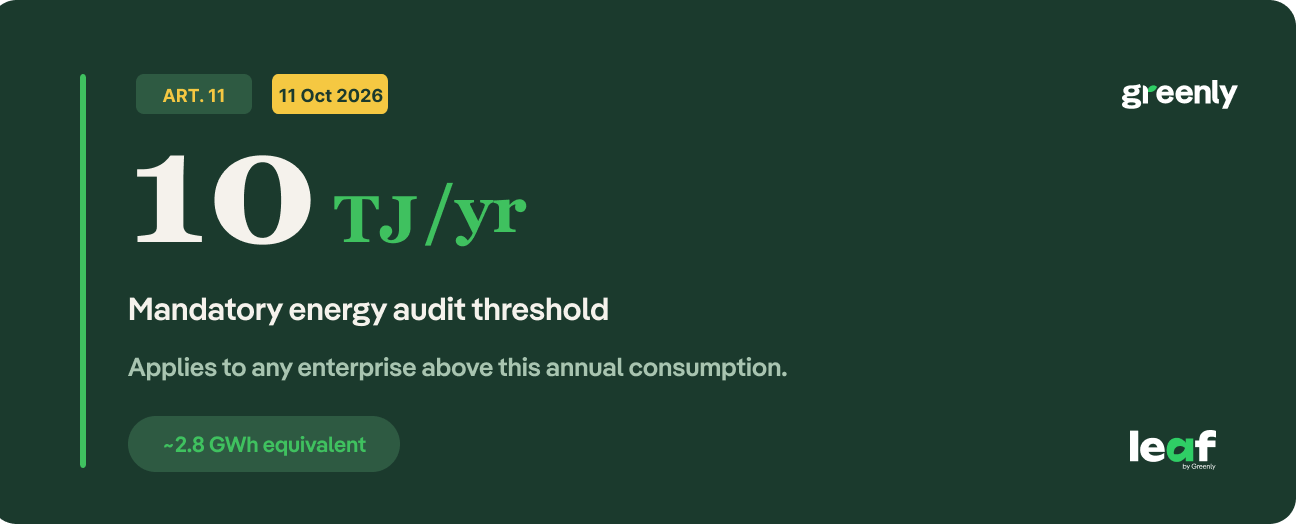
Enterprises with average annual energy consumption above 10 TJ (approximately 2.78 GWh) over the previous three years: first energy audit due by 11 October 2026, then every four years (Source: Directive (EU) 2023/1791, Article 11)
Enterprises above 85 TJ (approximately 23.6 GWh): certified energy management system such as ISO 50001 required by 11 October 2027 (Source: Directive (EU) 2023/1791, Article 11)
Every audit must be followed by a published Action Plan identifying the measures the operator will implement
Indirectly affected:
Colocation tenants whose providers will pass through KPI requests
Enterprises running on-premises infrastructure that crosses the 10 TJ threshold once data centre load is included
Non-EU operators selling capacity to EU customers, who will increasingly see ratings as a procurement criterion
📅 Timeline
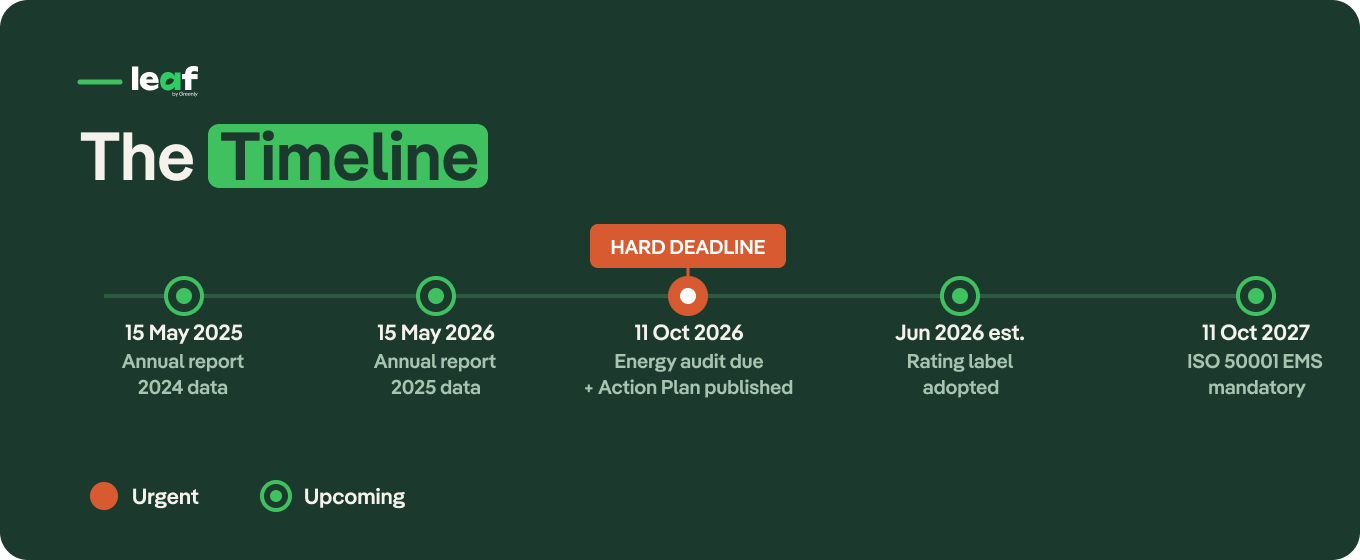
The compliance load builds across 2026. Operators have roughly four months between the rating label adoption and the audit deadline.
⚡ What this means strategically
For operators directly in scope: the rating label changes the economics. A public, comparable score affects financing terms, tenant negotiations, and asset value. Low-rated facilities will face the same dynamic as low-rated commercial buildings under EPBD, with capital cost penalties and rising vacancy risk.
For colocation tenants and enterprise customers: your provider’s rating becomes your indirect environmental profile. Procurement teams should expect rating disclosure to enter standard RFPs from 2027 onward, particularly in sectors already reporting Scope 3 under CSRD or ISSB.
For non-EU operators with EU exposure: even without direct reporting obligations, you will face contractual demands for the same data, because your EU customers need it for their own disclosures and procurement scoring.
The regulation does not just measure data centres. It prices them.
🔎 One thing most summaries miss
Most coverage frames Article 12 reporting and Article 11 audits as separate workstreams. They are not. The audit Action Plan is published, not filed privately with the auditor. Every operator above 10 TJ must publicly commit to implementing audit recommendations or explain why they will not. No other industrial sector in Europe faces this combination of mandatory KPI disclosure, public rating, and published improvement plan in the same 12-month window.
🚀 What you should do now
If your facility crosses 500 kW IT power, verify your 15 May filing is registered and start modelling where your KPIs will sit against the draft rating thresholds.
If your annual energy consumption is approaching 10 TJ, scope your audit provider now. Data collection across multi-site portfolios routinely takes longer than the audit itself.
If you operate above 85 TJ, the 2027 EMS certification depends on foundational work that must happen in 2026. Treat ISO 50001 readiness as a 2026 project, not a 2027 one.
Operators already maintaining a Scope 1 and 2 inventory have most of the data backbone for both Article 12 KPIs and Article 11 audits. Mapping the two against your existing carbon accounting infrastructure removes a duplicate workstream that compliance teams often run in parallel by default.

👉 Mapping your data centre obligations before October 2026? Talk to Greenly
